What Exactly is a Digital Battery Passport (DBP)?

Rohith Palani
By 2027, the "black box" era of energy storage officially ends. Under the EU Battery Regulation (2023/1542), every EV and industrial battery over 2kWh sold in the European market will require a Digital Battery Passport (DBP).
But let’s clear up a common misconception. A DBP isn’t just a static PDF hosted on a server. It is a dynamic "digital twin", a living record that evolves as the battery moves from the factory floor to the chassis of an EV, and eventually, to a second-life storage facility or a recycling plant.
The Anatomy of a Passport: What’s Under the Hood?
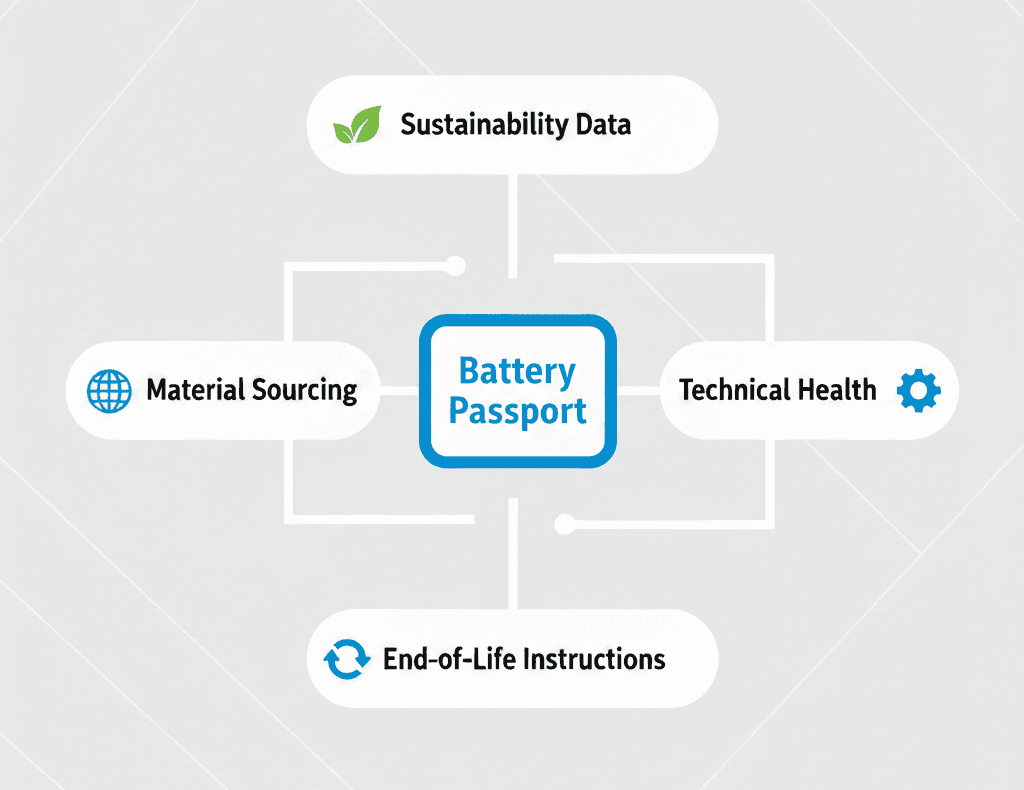
A DBP is a complex data set designed to provide transparency across the entire value chain. To be compliant, your passport must aggregate data from multiple stakeholders. Here is how we break down the mandatory requirements:
1. Product Identity & Traceability
This is the "Birth Certificate." It includes the manufacturer’s details, manufacturing date, and a unique identifier (typically a QR code) that links the physical unit to its digital counterpart.
2. Technical Performance & Durability
This is the "Medical Record." For fleet managers and second-life buyers, this is the most critical section. It tracks:
- State of Health (SoH): Remaining capacity vs. original capacity.
- Cycle Life: How many times the battery has been charged/discharged.
- Temperature Histories: Critical for assessing potential degradation.
3. Sustainability & Circularity
The DBP must disclose the Carbon Footprint Declaration. This calculates the total CO2 equivalent emitted during production. Additionally, it tracks the percentage of recycled content (Lithium, Cobalt, Nickel) used in the cathode.
4. Supply Chain Due Diligence
This ensures the minerals inside weren't sourced through unethical labor. It requires verified reports on the origin of raw materials, creating a "chain of custody" that was previously impossible to track at scale.
Why the DBP is a "License to Operate"
If you are an exporter, the DBP is no longer optional. It is your license to operate. Without a compliant, verifiable passport, batteries will be flagged at EU customs, leading to massive logistical bottlenecks and potential fines.
However, the DBP isn't just a regulatory hurdle; it’s a massive commercial opportunity. By providing a transparent view of a battery's health, manufacturers can:
- Increase Resale Value: Prove the quality of used batteries for the "second-life" market.
- Streamline Recycling: Give recyclers the exact chemical composition of the battery so they can recover materials more efficiently.
- Build Consumer Trust: Use the "Insights" tag to show customers exactly how green their vehicle really is.
"The passport transforms a 'black box' product into a transparent asset, enabling a truly circular economy where no watt-hour is wasted."
Solving the Data Nightmare with SaaS
The challenge for manufacturers isn't just having the data, it's managing it. Data for a single DBP often lives in five different silos: ERP systems, supplier spreadsheets, lab testing reports, and BMS (Battery Management System) logs.
Our SaaS solution acts as the "Single Source of Truth." We automate the data aggregation, calculate the carbon footprint based on your BOM (Bill of Materials), and generate the compliant QR codes for your production line in real-time.
Ready to automate your compliance? The road to 2027 is shorter than it looks. Let's get your data in order.