The Ultimate Guide to the New EU Battery Regulation (2026 Update)

Rohith Palani
The European Union is no longer just a market; it is now the world’s most sophisticated regulator of battery technology. With the full enforcement of the EU Battery Regulation (2023/1542), the industry has moved from voluntary "green" initiatives to legally binding transparency.
For exporters, the learning curve is steep. This guide breaks down the three foundational pillars of the regulation that you must master to remain competitive.
Pillar 1: Sustainability & The Carbon Threshold
As of February 2026, the focus has shifted to industrial batteries. Manufacturers must now calculate and declare the Global Warming Potential (GWP) of their products.
This isn’t a vague "eco-friendly" label. It is a precise mathematical declaration: kg CO2e per kWh of total energy provided over the battery’s expected service life.
- Performance Classes: Soon, the EU will categorize batteries into "Carbon Classes" (A through G).
- The Hard Cap: By 2028, the EU will set a maximum carbon threshold. If your production process is too "dirty," your product will be legally barred from the market, regardless of its price or performance.
Pillar 2: The Circular Economy & "Design for Life"
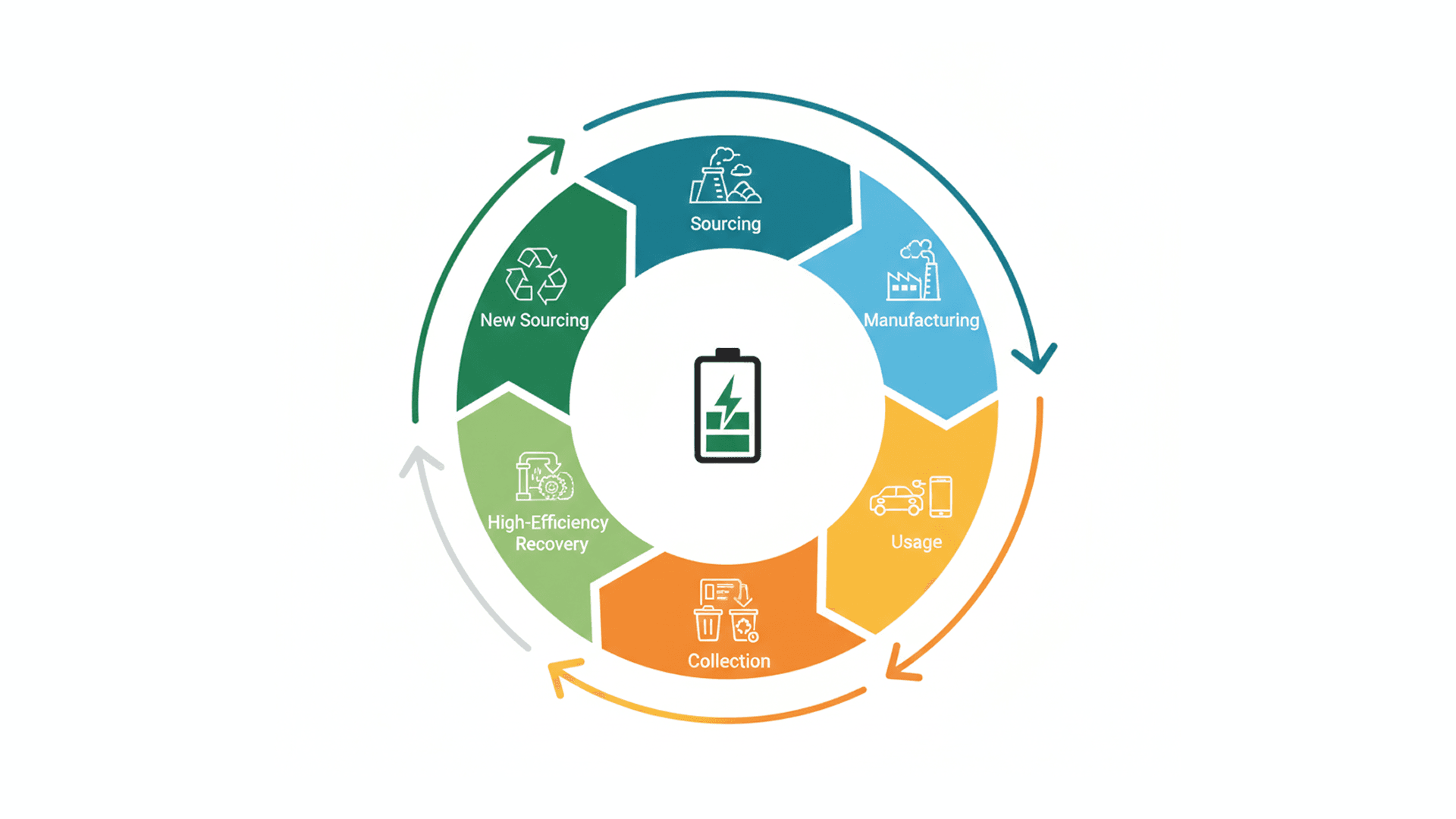
The EU’s goal is to ensure that no battery ever reaches a landfill. This pillar introduces two major challenges for design engineers:
1. Removability & Replaceability (The 2027 Deadline)
By February 2027, portable batteries in consumer electronics must be user-replaceable using common tools. For EV and industrial batteries, they must be replaceable by independent professionals. This means the era of "glued-in" batteries is officially over.
2. Mandatory Recycled Content (The 2031 Targets)
The regulation is creating an artificial demand for recycled minerals. By 2031, new batteries must contain minimum levels of recycled materials:
- 16% Cobalt
- 6% Lithium
- 6% Nickel
- 85% Lead
Your Digital Battery Passport will be the tool used to verify these percentages. Without digital proof of the "recycled pedigree" of your materials, you cannot meet these quotas.
Pillar 3: Ethical Sourcing (The Due Diligence Engine)
While the enforcement of third-party audits for due diligence was delayed to August 2027, the data collection requirement is already active. You must prove that your cobalt, lithium, and natural graphite were not sourced at the cost of human rights or environmental devastation.
This requires a Due Diligence Management System that tracks:
- Names and addresses of raw material suppliers.
- Country of origin for every gram of active material.
- Third-party verification of the mine sites.
Why a "Manual" Strategy Will Fail
The sheer volume of data required for a single battery from GWP calculations to mineral certificates of origin is staggering. Managing this via email and spreadsheets is not just slow; it’s a liability risk.
Our SaaS platform was built to be your Compliance Engine. We handle the heavy lifting:
- Automated LCA: Calculate your Carbon Footprint (kg CO2e) automatically based on your BOM.
- Supplier Portal: A secure way for your Tier 2 and Tier 3 suppliers to upload their due diligence data.
- QR Generation: One-click generation of the mandatory QR code that links directly to your DBP.
The landscape is changing fast, and the 2027 "Passport Deadline" is the final destination. Stay ahead of the curve by digitizing your compliance today, before the "Customs Wall" goes up.