The 2027 Countdown: A Roadmap to EU Battery Compliance

Venkat Kishore
The EU Battery Regulation (2023/1542) isn't just another layer of red tape, it is the most ambitious circular economy law in the world. For global exporters, this legislation fundamentally changes the business model from a "sell and forget" transaction to a "trace and report" lifecycle.
If you haven't started mapping your data yet, you are already behind the curve.
The Compliance Timeline: 2024 to 2031
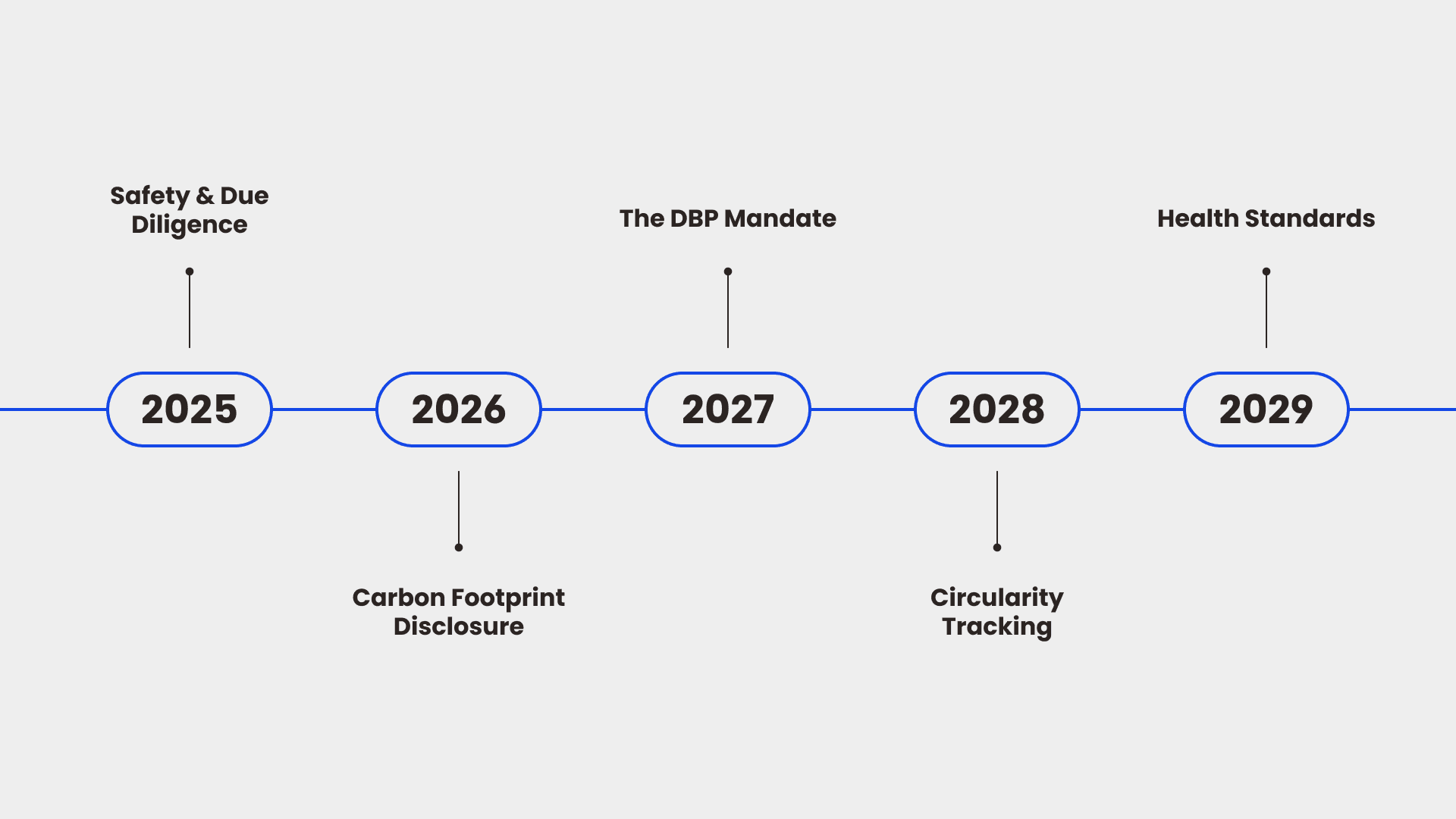
The regulation is a phased rollout. While the Digital Battery Passport (DBP) is the headline-grabber for 2027, several high-stakes requirements kick in much sooner.
Phase 1: The Safety & Carbon Baseline (2024–2025)
- August 2024: Mandatory CE marking and safety requirements for stationary energy storage systems came into effect.
- February 2025: Carbon Footprint Declarations for EV batteries. Manufacturers must now report the total CO2e emitted per kWh of energy provided over the battery's life.
- August 2025: Mandatory Supply Chain Due Diligence. Large operators must prove they are addressing social and environmental risks in their mineral sourcing (Lithium, Cobalt, Nickel, and Graphite).
Phase 2: The Digital Revolution (2026–2027)
- February 2026: Carbon Footprint requirements extend to rechargeable industrial batteries.
- February 18, 2027: The Digital Battery Passport becomes mandatory for all LMT (Light Means of Transport), industrial (>2kWh), and EV batteries.
- February 18, 2027: New "removability and replaceability" rules for portable batteries take effect, requiring products to be designed so users can easily swap out cells.
Phase 3: The Circularity Mandate (2028–2031)
- August 2028: Mandatory documentation of recycled content begins.
- August 2031: Binding targets for recycled content (e.g., 16% Cobalt, 6% Lithium, and 6% Nickel) must be met for every battery placed on the market.
The "Customs Wall": Why 2027 is a Hard Stop
The February 2027 deadline is unique because it introduces a physical barrier. Without a unique QR code linked to a verified DBP, your batteries cannot technically be "placed on the market."
Under Article 84, non-compliant products must be withdrawn from the market, and member states are empowered to levy significant fines. For an exporter, this means a shipment stuck at a port in Rotterdam isn't just a delay, it's a total loss of market access.
Action Plan: 3 Steps to Take in 2026
To be ready for the 2027 mandate, your "Phase 0" should be happening right now.
- Supply Chain Data Audit: Reach out to your Tier 1 and Tier 2 suppliers. Do they have the elementary flow data for carbon calculations? Do they have a verified chain of custody for their minerals?
- BMS Integration: Ensure your Battery Management System (BMS) is capable of recording dynamic data like cycle counts and temperature logs, which must be fed into the passport periodically.
- SaaS Infrastructure Selection: You cannot manage 10,000 unique battery passports using Excel. You need a platform that can automate the data aggregation and generate compliant QR codes that stay "alive" even if your company changes hands or closes.
Compliance shouldn't be seen as a burden, but as a competitive advantage. Exporters who can demonstrate high "State of Health" and low carbon footprints by 2026 will become the preferred partners for EU-based OEMs who are desperate for transparent, compliant supply chains.
Don't wait for 2027. Let's start building your roadmap today.